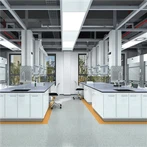
In scientific research and experimental environments, the laboratory bench is an indispensable infrastructure. In order to improve experimental efficiency, ensure experimental safety and optimize the working environment, it is crucial to choose the right laboratory bench accessories. This article will explore several key laboratory bench accessories, including faucets, sinks, lockers, work surfaces and power sockets, and introduce their characteristics and selection points.
1. Faucets and sinks
Laboratory faucets and sinks are accessories frequently used in daily experiments. They not only need to meet basic cleaning needs, but also need to be corrosion-resistant, easy to clean and durable. For example, the JH-WT027 laboratory faucet is made of national 59-1 grade high-quality brass material, and the surface is treated with advanced matte epoxy powder coating, which can resist the erosion of most chemicals, while preventing ultraviolet fading and high temperature deformation. Its ceramic valve core design ensures a service life of up to 500,000 times, and is equipped with a removable serrated nozzle and splash-proof filter, which further enhances the convenience and safety of use.
Laboratory sinks are often made of PP (polypropylene) or stainless steel, which are not only corrosion-resistant but also easy to clean. PP sinks are popular for their light weight and impact resistance, while stainless steel sinks are known for their high strength and aesthetics.
2. Lockers and drawers
Laboratory lockers and drawers are important facilities for storing experimental equipment, reagents and samples. Depending on the items stored, lockers can be divided into various types such as wood, steel and PP. Wooden lockers usually use environmentally friendly double-sided MDF boards or melamine boards, and the edges are sealed to ensure that there are no burrs and no odors. Steel lockers are favored for their durability, heavy load-bearing, fireproof and moisture-proof characteristics. The surface is phosphated and electrostatically powder-coated, which is both beautiful and practical.
The design of drawers should take into account the convenience of use and the maximum utilization of space. For example, drawers with silent slides and buffer hinges not only open and close smoothly, but also effectively reduce noise and wear. In addition, the dividers inside the drawers can be customized as needed to classify and store items of different sizes.
3. Work surface
The laboratory work surface is the platform directly operated by the experimenter. The choice of its material directly affects the accuracy and safety of the experiment. Common work surface materials include phenolic resin, epoxy resin, ceramic, HPL (high pressure laminate) and Trespa.
Phenolic resin countertop: It has excellent acid and alkali resistance, wear resistance, high temperature resistance and radiation resistance, and is suitable for physical, chemical and medical laboratories.
Epoxy resin countertop: It can withstand high temperatures up to 600°C, has strong corrosion resistance, and is not easy to deform. It is especially suitable for work areas that need to frequently contact chemical reagents.
Ceramic countertop: It has extremely high hardness and corrosion resistance, but the price is relatively high. It is suitable for laboratories with extremely high requirements for countertops.
HPL and Trespa countertops: beautiful and durable, easy to clean, suitable for a variety of laboratory environments.
4. Power sockets and lighting
The power sockets in the laboratory must meet the requirements of safety, convenience and flexibility. Usually, the laboratory workbench is equipped with multiple power sockets to meet the power needs of different equipment. The socket should have overload protection and leakage protection functions to ensure experimental safety. In addition, the lighting design of the laboratory is also crucial. It should ensure that the working area is well-lit and evenly lit to reduce visual fatigue and improve work efficiency.
5. Other accessories
In addition to the above main accessories, the laboratory workbench can also be equipped with other auxiliary facilities as needed, such as fume hoods, emergency eyewash stations, gas interfaces and exhaust systems. These facilities can further improve the safety and work efficiency of the laboratory, ensure the personal safety of the experimenters and the accuracy of the experimental results.
Conclusion
Choosing the right laboratory workbench accessories is the key to improving laboratory efficiency, ensuring experimental safety and optimizing the working environment. By comprehensively considering factors such as material, performance, durability and safety, it can be ensured that the selected accessories can meet the actual needs of the laboratory and provide a safe, efficient and comfortable working environment for the experimenters.