1. Analysis of key points of laboratory function and equipment design
(1) Reagent storage area
This area mainly completes the storage, preparation and packaging of reagents and main reaction mixtures. All reagents and materials transported to this area should not pass through other areas, and reagents and raw materials should be stored and prepared in this area. The air pressure in this area should maintain a positive pressure relative to the outside world. The equipment in this area is mainly refrigerators, balances, mixers, low-speed centrifuges, samplers, movable ultraviolet lamps, etc. Since there are many kinds of reagents in this area, "safety" should be the primary consideration in the graphic design, and the graphic design should maintain smooth ventilation and smooth escape. First of all, the test benches are arranged on both sides of the room, and the aisles in the middle all lead to the corridor for easy evacuation. At the same time, according to the international ergonomics standards, the channel between the test bench and the test bench is designed to be 1500mm, and the channel in the middle can meet the requirements of people sitting on both sides.
(2) Specimen preparation area
The functions of this area are sample preservation, nucleic acid extraction and storage, sample addition to amplification reaction tubes and determination of DNA synthesis. Samples should be directly transported to and stored in this area, and should not pass through other areas. For the control of the airflow pressure, since the sample addition operation in this area may generate aerosols, in order to prevent the aerosol from diffusing out and causing pollution to the outside world, this area should maintain a negative pressure outside; The increase area and the amplification product analysis area are under positive pressure to avoid aerosol pollution entering this area from adjacent areas.
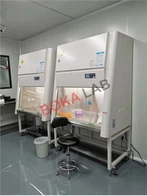
The equipment in this area is mainly biological safety cabinets, sample injectors, desktop high-speed centrifuges, desktop low-speed centrifuges, water baths, refrigerators, mixers, and movable ultraviolet lamps. It should be noted that the B2 type of biological safety cabinet is the best choice. All the inhaled airflow and vertical airflow of this biological safety cabinet are filtered by high-efficiency filters and then discharged to the outside, and will not enter the biological safety cabinet for circulation or return to the area. This kind of biological safety cabinet can avoid the repeated circulation of extracted nucleic acid in the cabinet, causing cross-contamination between samples and false positive results.
(3) Amplified area
The function of this region is DNA amplification and determination of amplified fragments. In addition, the reaction mixture (from the reagent storage and preparation area) is prepared into the reaction mixture and the addition of the prepared DNA template (from the sample preparation area) can also be carried out in this area. For the control of airflow pressure, it is negative pressure relative to the adjacent area to avoid aerosol leakage from this area. In order to avoid pollution caused by aerosols, unnecessary walking in the area should be minimized. Individual operations such as adding samples should be carried out in a clean bench.
The equipment in this area is mainly nucleic acid amplification thermal cycler, sample injector, ultra-clean bench, etc. The power supply of the thermal cycler should be dedicated, and equipped with a stabilized power supply or UPS to prevent the impact on the amplification measurement due to voltage fluctuations.
(4) Analysis area
The function of this region is the analysis of amplification products. Some toxic substances that can cause mutations may be used in this area, and special attention should be paid to the safety protection of experimenters. For the control of airflow pressure, this area is the last step of the PCR experiment, and the pressure should be the lowest, and it should be negative pressure relative to the adjacent area to avoid aerosol leakage from this area. In order to avoid pollution caused by aerosols, unnecessary walking in the area should be minimized.
The equipment in this area is mainly sample injector, electrophoresis apparatus (tank), electrotransfer apparatus, hybridization furnace or hybridization box, water bath box, DNA sequencer, microplate reader and plate washer, etc.